Are online economics lessons as good as in-person?

I (George Chantry) voice dictated every one of these articles to give my honest, transparent view on economics A-Level tutoring to answer parent questions, having worked in the tutoring industry for nine years. Please WhatsApp me if you want to discuss anything in the articles further or have any further questions.
Parents ask me this all the time, and it's a fair question. The instinct is that a tutor sitting in the room with your child must be doing something a screen can't. My honest answer is the opposite of what you'd expect: for A-Level Economics, teaching online doesn't cost you anything — and in the way that matters most, it gives your child something an in-person tutor can't realistically offer.
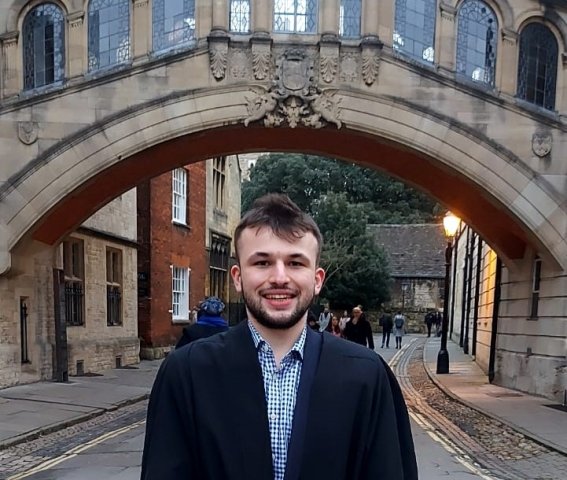
Before I explain why, the short version of who I am: a first-class degree in PPE from Oxford, three prizes in economics, and the best mark in my year in Game Theory. I've taught 145 one-to-one students, almost all of them now entirely online via Zoom.
Why online is a feature, not a compromise
Here's the thing most parents haven't considered: when I teach online, I record every single lesson and have a full transcript of each one.
That gives me a far more detailed record of your child's specific weaknesses than an in-person tutor could realistically keep. An in-person tutor relies on memory and a few scribbled notes. I have the whole lesson — every question your child hesitated on, every chain of reasoning that fell apart, every point where they said "yes, I get it" but the answer told a different story. I can go back over it.
So online isn't the limitation people assume. The digital environment makes a level of diagnostic precision possible that in-person simply can't match.
What I do with the recordings
I use those recordings to plan the next lesson minute-by-minute around the exact gaps I've identified. Not roughly, not "we'll do some macro" — minute-by-minute, on the specific things that are costing your child marks.
And over time I build a per-student typology of where each one is losing marks: the topics they avoid, the question types they misread, the evaluation points they never quite land. That map only gets sharper the longer we work together, because every lesson adds to the record.
This is why the recording matters so much. Continuous, detailed checking of what a student can and can't do is one of the most powerful things a teacher can do. The research on formative assessment (Black & Wiliam, 1998) found that this kind of constant, low-stakes measurement is associated with some of the largest measured learning gains. Recording and transcribing every lesson is how I do that at a level of detail that isn't possible when the only record is what a tutor happens to remember.
The results speak for themselves
Here's the part that should settle it: most of my students who went on to get Oxbridge results were taught online-only. That's the top of the tree, and it was done over Zoom.
It's not only the very top end. One of my A-Level Economics students came to me for a retake, studying entirely via Zoom, and jumped from a Grade D to a Grade A on results day and got into his first-choice university.
"He was extremely clear in explaining concepts and filling in any gaps that our son hadn't grasped in group classes at Sixth Form College... it helped that our son could do the classes via Zoom... Update on A level results day — our son jumped from a Grade D to a Grade A and has got into his first choice of university."
Emilie, parent, on results day
"But where are you actually based?"
The other half of this question is usually about geography, so let me answer it plainly. I split my time between the UK and Europe — my partner is European. All my tutoring is online now via Zoom, with the occasional in-person session when a student happens to be near Haslemere. There's no downside to your child in that.
The honest limitation
I should tell you where online is not the perfect fit, so here it is. For a very weak or very shy student, online tutoring can sometimes be less effective at first — simply because you don't so easily discover what they can't do. A quiet student who nods along can hide a gap for a while.
But there are easy ways around this, and they're the same tools that make online powerful in the first place. I build large quizzes that test the foundational building blocks of the subject, and I often ask a student to send me a scan of their entire economics folder. What someone actually writes is a very good measure of what they've truly learned — so even with the shyest student, I don't have to rely on them telling me where they're stuck. I find it in the evidence.
"Even though the tutoring has been remote, it has been outstanding. I couldn't imagine it being any better in person."
Parent of a student taught entirely online
So — is online as good as in-person?
For A-Level Economics, yes — and for the thing that actually moves grades, accurate measurement of what your child can and can't do, it's better. Every lesson is recorded, transcribed, and turned into a plan for the next one. That's not something I could do sitting across a kitchen table, and it's how students go from a D to an A.
Have a question about your child’s A-Level Economics? Message me — I reply to every one personally.
WhatsApp George — free initial call